
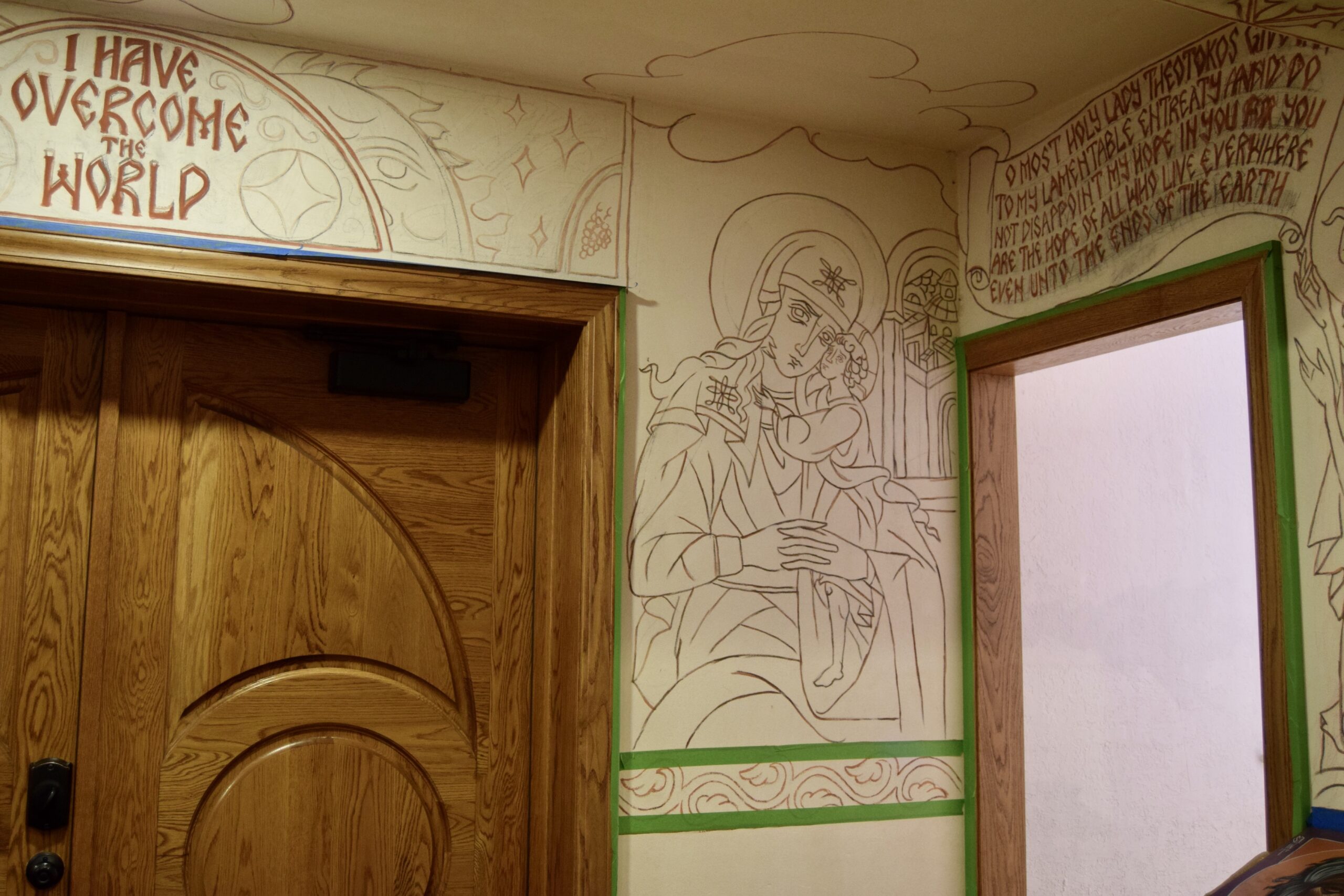
This icon depicts the moment when the Theotokos was reunited with the 12-year-old Christ in the temple in Jerusalem. This story is recounted by St. Luke in the second chapter of his Gospel:
Now his parents went to Jerusalem every year at the feast of the passover. And when he was twelve years old, they went up to Jerusalem after the custom of the feast. And when they had fulfilled the days, as they returned, the child Jesus tarried behind in Jerusalem; and Joseph and his mother knew not of it. But they, supposing him to have been in the company, went a day’s journey; and they sought him among their kinsfolk and acquaintance. And when they found him not, they turned back again to Jerusalem, seeking him. And it came to pass, that after three days they found him in the temple, sitting in the midst of the doctors, both hearing them, and asking them questions. And all that heard him were astonished at his understanding and answers. And when they saw him, they were amazed: and his mother said unto him, Son, why hast thou thus dealt with us? behold, thy father and I have sought thee sorrowing. And he said unto them, How is it that ye sought me? wist ye not that I must be about my Father’s business? And they understood not the saying which he spake unto them. And he went down with them, and came to Nazareth, and was subject unto them: but his mother kept all these sayings in her heart. And Jesus increased in wisdom and stature, and in favour with God and man.
Luke 2:41-52 KJV
There is some mystery in the title “Seeker of the Lost,” as Christ was not really “lost,” but intentionally stayed in the temple to do His Father’s business. But to His Mother, He was lost, and she sought Him “sorrowing.” Likewise, she seeks us who have strayed from her motherly embrace and from the path of true Christianity. To be a Christian, to be on the narrow path, means striving to imitate the Theotokos in humility, chastity, and obedience. She is our mother. When we stray, she does not just seek us; she seeks us sorrowing.
Other titles of this icon shed more light on the spiritual meaning of the icon. The icon is also called The Searcher for the Lost, The Seeker of the Perishing, and The Recovery of the Dead.
The precise origins of this type of icon are unknown, but date back at least to the seventh century:
The Life of Saint Theophilus of Adana presents a narrative of his falling into a deadly sin and miraculous salvation from eternal death by the intercession of the Most-Holy Theotokos. Theophilus, who was working as a housekeeper for a bishop, had been unfairly accused and expelled from the household. Seeking to revenge his accusers, he engaged with the forces of evil. Soon, he came to his senses, but he did not dare to ask God for His forgiveness directly but instead petitioned the Most Holy Theotokos. She answered his prayers quickly. Miraculously, Our Mother in Heaven informed the monk about his forgiveness and returned to him the contract with the devil that he had signed. The repentant monk grew in God and reached perfection in the spirit, and was glorified by the Church. This incident illustrates the origin of the name “Recovery of the dead” and the power of the intercession of the Virgin Mary as the last resort in the most difficult and desperate situations of our lives.
Seek Us Who Are Perishing, O Holy Lady, St. Elisabeth Convent Minsk
More than a thousand years later, the Mother of God worked another miracle through this icon, again saving a person who had no other hope:
In the mid-eighteenth century, in the village of Bor (Kaluga Gubernia), the pious peasant Theodotos Obukhov lost his way in a blizzard on the Feast of the Lord’s Baptism. The horse became exhausted and paused on the edge of an impassable ravine. Seeing no way to save himself, Obukhov lay down in his sleigh, where he began to freeze.
In these terrible moments, he prayed with all his being, asking the Queen of Heaven for help, and he vowed that if he were rescued he would have a copy of the “Seeker of the Perishing” Icon painted and donate it to his parish church. She heard his prayer and helped him in a marvelous way. A certain peasant in the nearby village heard a voice outside his window saying, “Take him.” He went out and saw the half-frozen Obukhov on his sleigh. When he recovered his health, Obukhov fulfilled his vow and commissioned a copy of the Icon from the Saint George church in the city of Volkhov (Orlov Gubernia). From that time the Bor “Seeker of the Perishing” Icon was glorified by many manifestations of grace and miracles.
Icon of the Mother of God “Seeker of the Perishing”, Orthodox Church in America
For more accounts of the miracles worked by the Most Holy Theotokos, the Seeker of the Lost, see the rest of the article from the St. Elisabeth Convent Minsk.
Our Sisterhood was originally dedicated to St. Elizabeth the New Martyr. We had no intention of changing patrons, but the Mother of God came to us in an unmistakable way. She simultaneously took us under her wing and showed us that we have been under her wing the whole time. Of course, she is the Protectress of all Christians, but there is something particular about her care for monastics, and even more so for women who have chosen this path in the midst of a society completely given over to sin and depravity.
Most of us never thought we would be nuns; some of us had never even heard of monasticism. We are here because the Theotokos sought us. She knew what God had for us, which was far above and beyond what we could have imagined.
Her process of seeking lost souls is exemplified in the life of St. Silouan the Athonite:
Simeon, chosen of God, was called again, this time by means of a certain vision, which followed on a period of wild living. He had dozed off and was in a light sleep, when he dreamed that he saw a snake crawl down his throat. Feeling sick with revulsion, he awoke to hear a voice saying, ‘Just as you found it loathsome to swallow a snake in your dream, so I find your ways ugly to look upon.’ Simeon saw no one. He only heard the voice, extraordinarily sweet and beautiful; but for all its gentleness, the effect it had on him was revolutionary. He was convinced beyond doubt that he had heard the voice of the Mother of God herself, and to the end of his life he gave thanks to her for coming to lift him from his degradation.
St. Sophrony, St. Silouan the Athonite
While not everyone will experience the action of the Mother of God in such an explicit revelation, she knows us and has her way of getting through to each of us.
Among the sisters, we have at times wondered, “What would it be like if we met each other in our former lives?” On the surface, this question seems amusing, but it brings up feelings of sadness and shame. It is likely that our former selves would not have gotten along – we may even have judged and despised one another, as is typical of so many female relationships in the world. We are united now only because we are in Christ, under the omophorion of the Mother of God, and we find true harmony only when we are each actively working to imitate her.
Not only did we have no idea we would end up here, we could never have known that we would be who we are becoming. The personalities we had in the world were masks, crafted consciously or unconsciously, based on passions and ideas of who we thought we should be, based on desires to please or impress certain people, achieve a certain position, etc. Monasticism is a process of shedding these masks, which are many-layered, and the Mother of God helps us, seeking out and showing us our true selves in Christ, no matter how buried they may be, as her canon says:
Calm the disturbed and the agitated. Look upon the troubled, the confused and the depressed. Strengthen those persecuted for truth and those who hunger for justice and all in whom the divine image is buried and obscured.
Canon to the Mother of God, Seeker of the Lost, Ode Six
The Seeker of the Lost being our Patroness means that we do not turn anyone away. The only requirement for being here is wanting to be here, along with everything that entails. It also means that we are committed to remaining open to her work as she seeks the lost parts of ourselves – the divine image buried underneath layers of falsehood and filth. The process of recovery is painful, but she gives us everything we need to endure. Her troparion reminds us of the purpose of all of this: to treasure Christ in our hearts, and find eternally our Father’s house.
Troparion, Tone 4
Within the Temple, O Temple of Life, * you found Him whom the universe cannot contain, * silencing the teachers by the word of God which is above the wisdom of the wise. * O all-pure Mother of God, * cease not seeking your children who are lost; * that we may treasure Christ in our hearts, * and find eternally our Father’s house.
Kontakion, Tone 6
O Lady, strengthen our hearts and knees * and lead us healed along level paths. * For we have wandered far from your Son * into anger and loss and many sins. * Search for us who call on your name * and bring us safe into our Father’s house.