
During Vespers a few weeks ago, I caught a glimpse of a dad carrying his young daughter across the nave to light a candle. I was struck by the sweetness between them and by their physical resemblance to my father and me at about the same ages. It cut me straight to the heart, because I realized that my own dad and I once had the same sweetness—but I snuffed it out.
The profound sadness and remorse I felt in the wake of that revelation was almost unbearable. Desperate for guidance, I asked Father Turbo if there was anything I could do at this late hour to try to make spiritual amends, and he advised me to pray for my father in a specific way every day until further notice.
Thank God for that direction. It has borne good fruit.
I have many regrets concerning my father and the course of our relationship. It’s something I have written quite a bit about, both for publication and in direct correspondence with my dad. I have known for over a decade that I’d misjudged him and made a major mistake when I cut him out of my life for a span of fifteen years between my early twenties and my mid-thirties. But my comprehension of the details was somewhat vague and difficult to articulate.
That is no longer the case, because during my prayers for my father, God has shown me the complete roadmap of all my wrong turns in our relationship. God has reminded me that my father has gone to extraordinary lengths on my behalf—not just once or twice, but as a matter of course. And God has revealed to me just how remarkable a man my dad really is.
To cite just one example:
When I was six years old and my brother was nine, we went to visit my maternal grandmother one weekend. We were living with my mom and her boyfriend, who was subjecting my brother to horrific abuse on a near-daily basis. That weekend, my grandmother discovered evidence of that abuse on the backs of my brother’s legs.
Unwilling to return us to my mother under the circumstances, my grandmother called up my dad, and he and my stepmom agreed to take us in—without any chance to prepare and in spite of the fact that my brother is not my father’s child. Within hours, we were on a plane heading their way.
My brother and I were understandably pretty messed-up as a result of the abuse and neglect we’d endured. In addition to my brother’s predictable array of behavioral problems, we both lacked fundamental skills, like how to use a knife and fork. I personally didn’t know how to wipe myself properly after using the bathroom—although my mom had me scrubbing our toilet since I was in kindergarten, she had never taught me how to clean myself.
I remember having a moment of realization early on after moving to my dad’s that I was woefully unprepared for life there; I felt a bit like I had been raised by wolves up to that point and was suddenly having to navigate life in civilized society. In hindsight, that assessment seems even more apt.
Nonetheless, my dad was game for the challenge. He was in legal limbo with regard to both my brother and me, since he didn’t have custody rights for either of us. But he took us in, taught us how to live like normal people, fed us, clothed us, coached our sports teams, and helped us with our homework. In my brother’s case, he patiently endured behavioral issues that would have caused most people to give up in exasperation—and he risked going to jail to do it.
Later, when my mom reasserted her custody rights, he went to court to fight her and try to keep me. He would have fought for my brother, too, if there had been even the slightest chance of winning.
As a young adult, I had interpreted many things that happened over the years I lived with my dad and those immediately thereafter as evidencing insensitivity or even cruelty on his part. God has now shown me that all of those things actually evidenced his profound love. He was simply prodding me—a nervous and anxious kid who was shell-shocked as a result of the abuse I had survived—to overcome my fears. He was pushing me to be better and stronger because he saw potential in me that I did not see for myself.
He was doing what dads are supposed to do—encouraging me to embrace struggles and challenges because he knew they are necessary for growth. On an individual scale, he was doing exactly the same thing God does for all of mankind.
And indeed, even in the midst of my misjudgments about my dad, I still considered the two years I lived with him to be the only happy ones of my entire childhood. Why, then, in the face of that and other evidence, did I reject my father?
When I first wrote about this back in 2018, I concluded that my having bought into my mother’s lies about my dad explained why I turned against him. This is not untrue—but it’s also not the whole truth.
God has since shown me that the reason I bought into her particular lies was because I bought into an even bigger lie—namely, feminism.
Demonic Psychology
Father Turbo frequently says that demons go to great lengths to impress their psychology upon us. He also emphasizes that envy was the reason the demons fell.
What is envy? Envy happens when we want what someone else appears to have, and we hate them for having it.
Feminism is rooted in the idea that men have things women justly deserve but currently or historically lack. Although the early feminists may not have been motivated by animus, over the years, feminism has evolved into an ideology of hate, teaching women to despise men for alleged injustices.
In other words, feminism is a form of envy. Envy is demonic; ergo, feminism is demonic.
In fact, feminism has been a smashing success for the demons—by means of this poisonous ideology, they have impressed their psychology upon millions, thereby dividing humanity against itself.
But the carnage wrought by feminism is even more insidious than it at first appears. It has prompted innumerable individuals to fundamentally reject nature and the created order—which is really a rejection of God. By teaching women to envy men, feminism has taught women to hate their own created nature and to strive after things contrary to it.
That striving prompted the development1 of hormonal contraception, which aims to deny and derail the natural functions of female bodies—it has more in common with biological weapons2 than medicine. In spite of the litany of physical and psychological health problems3 hormonal contraceptives cause, millions4 of American women willingly ingest these carcinogenic5 drugs as if they were legitimately therapeutic because they believe their pesky biology is inhibiting their “success”—primarily in endeavors that are only truly natural for men.
Striving after the unnatural has also led to the proliferation of abortion—prenatal murder—which many women6 resort to after hormonal contraceptives fail.
But it doesn’t end there. The lie that human beings can—and often should—be and do things contrary to their created nature has led to the destructive ideology of transgenderism. In their efforts to achieve the impossible goal of swapping genders, numerous people, many of them mere children7, have irreversibly8 mutilated their healthy bodies through chemical and surgical interventions—and many have chosen to end their lives.9
And now, we are watching yet another permutation of the same lie unfold: transhumanism. It will have the same devastating results.
Each iteration of this demonic lie has one common theme: the degradation and destruction of humanity … which is the demons’ number-one goal. By adopting their ideologies, we do their work for them.
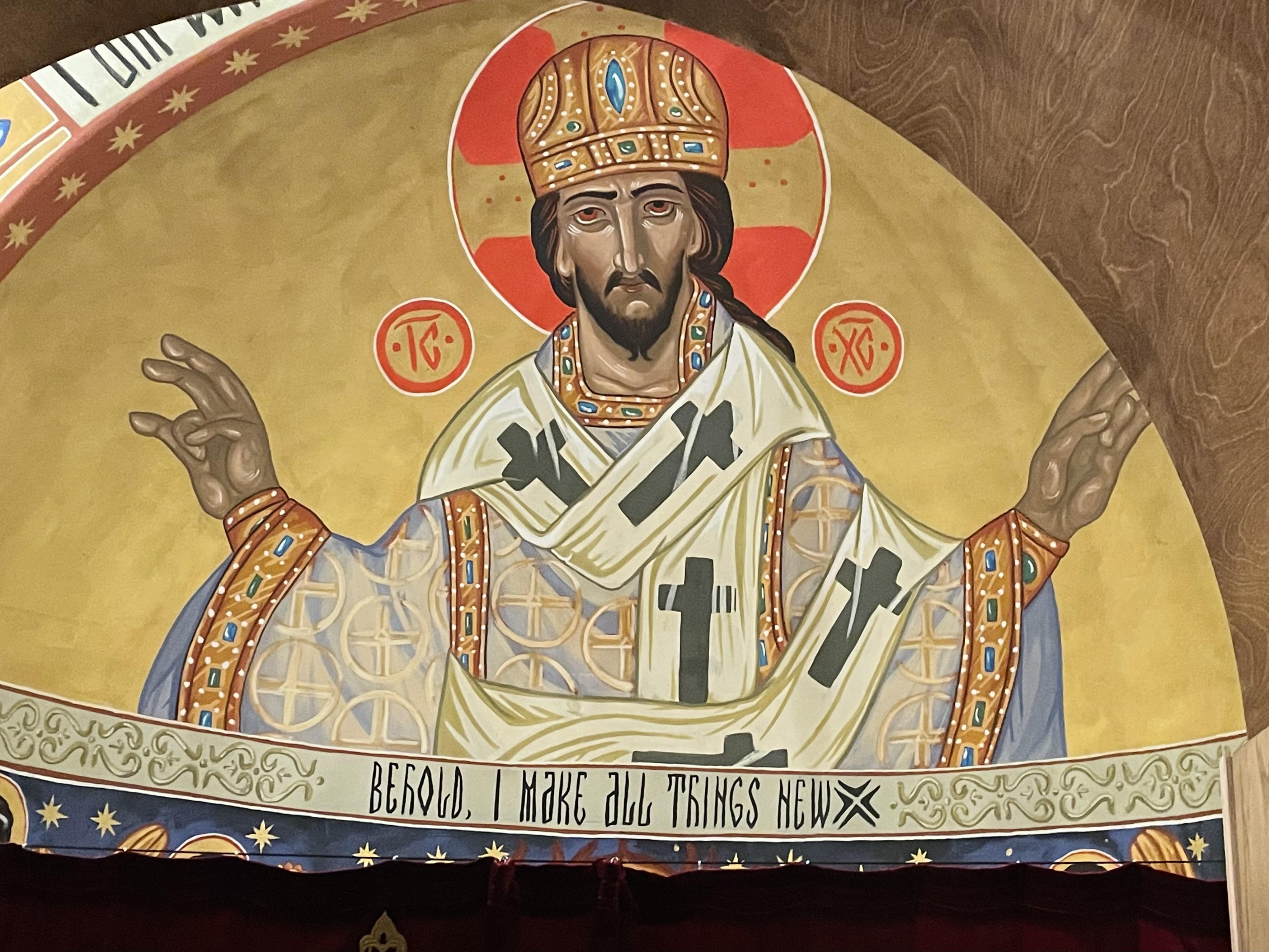
Ironically, there is only one method for actual transformation10, only one way to truly transcend what we currently are: by placing ourselves in the loving hands of the One who makes all things new11—the same God we reject when we reject our created natures.
From Rejection to Renewal
Feminism has convinced entire generations of women that patriarchy is responsible for all of humanity’s suffering. And if one wants to smash patriarchy, it makes sense to start with one’s own personal patriarch. Think globally, act locally, right? If a woman truly drinks the feminist kool-aid, rejecting her own father is virtually inevitable.
I certainly did.
The opening paragraphs of the reflection I wrote about my dad in 2018—just a few years after we reconciled—read:
Some of my fondest childhood memories are of sitting in the back of my father’s car, listening to the music he loves. He would pick me up from daycare in the late afternoon, and I would close my eyes and fall into whatever song was playing … Through my half-asleep reverie and half-lidded eyes, I would glance up and see my father smirking at me in the rearview mirror.
“Are you asleep back there?” he’d ask me, amused.
“No, Daddy,” I’d slur, “I’m just resting my eyes.”
In the supreme sweetness of those moments, I didn’t have to plan, or worry, or try to steer the situation to serve my own ends. I was secure in the conviction that I was in loving, capable, and protective hands that would pilot me wherever I ought to go.
I have spent the majority of my life trying to recapture that feeling.
It took me almost another decade to get here, but in pursuing monasticism, I have finally recovered that same serene security. When I was a child, the provision and protection of my father was the magic formula that produced the desired result. It still is—only this time, I have surrendered my life to my heavenly Father’s care.
That doesn’t mean I have abandoned all hope of making things right with my earthly father. Quite the contrary. In fact, I fully realize that both relationships are interdependent: to have a healthy relationship with either of my fathers, I must pursue a healthy relationship with the other.
To that end, I’m entrusting the repair and renewal of my relationship with my dad to the supremely capable hands of my heavenly Father, who made us both, loves us both, and knows exactly what we need.
I once made the excruciating mistake of adopting the psychology of demons. Consequently, I rejected my dad, my own nature, and my Creator. Henceforth, I hope to devote my life to repenting of all of that. And I’m counting on my Creator to renew my nature and heal the injuries I inflicted upon my dad.
I closed the reflection I wrote in 2018 with a quote from my father: “I do believe the ending, when it comes, can still be a great one, and I hope we can write it together.” I’m still pinning my hopes on his wish coming true—only now, I’m handing the pen to the Author of life and asking Him to guide us as we craft our final chapter.
- The disturbing story behind the development of hormonal contraception involves exploitation and unethical experimentation on poor and mentally ill women, precipitated and paid for by self-identified feminists. For more details, see The Bitter Pill: Harvard and the Dark History of Birth Control and Play tells of experiments on Puerto Rican women, tied to Planned Parenthood founder. ↩︎
- For one example of biological/chemical weapons research targeting fertility, see A Conspiracy to Commit Genocide: Anti-Fertility Research in Apartheid South Africa’s Chemical and Biological Weapons Programme. ↩︎
- For details regarding the harmful side effects of hormonal contraception, see How birth control pills affect the brain and Women deserve better than risky hormonal contraceptives. ↩︎
- The most recent CDC statistics on contraceptive use in the United States can be found here. ↩︎
- For details regarding the carcinogenic nature of hormonal contraception, see the World Cancer Report. ↩︎
- Data collected by the pro-contraception, pro-abortion Guttmacher Institute shows that about half of the women who obtain abortions in the United States were using contraception during the month they got pregnant.
↩︎ - The number of minors seeking and receiving so-called “gender-affirming care” (i.e. chemical and surgical interventions) has skyrocketed in recent years. Using data obtained by Komodo Health Inc, Reuters reported that the number of children receiving such interventions more than doubled between 2017-21, and the number of children diagnosed with gender dysphoria nearly tripled over the same period. ↩︎
- For details about the irreversible consequences of “gender-affirming” interventions, see Reevaluating gender-affirming care: biological foundations, ethical dilemmas, and the complexities of gender dysphoria. ↩︎
- For statistics concerning suicidality in individuals with gender dysphoria, see Gender Dysphoria Statistics in the United States. For statistics pertaining to the increase in suicidality following gender-related surgical interventions, see Risk of Suicide and Self-Harm Following Gender-Affirmation Surgery. ↩︎
- 2 Corinthians 5:17 (KJV): “Therefore if any man be in Christ, he is a new creature: old things are passed away; behold, all things are become new.” ↩︎
- Revelation 21:5 (KJV): “And he that sat upon the throne said, Behold, I make all things new. And he said unto me, Write: for these words are true and faithful.” ↩︎